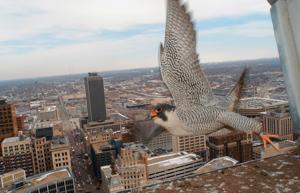
Many people have a romance for raptors. Maybe it’s because of their stealth and poise or grace in flight. When it comes to birds of prey, the peregrine falcon sits on the throne. They are the fastest animal on earth reaching speeds of 200 miles per hour on a spectacular, well-executed dive.
There have been two instances where I have witnessed peregrine falcons snatch a bird from mid-air and those are memories not soon forgotten.
The first was in downtown Indianapolis. Two falcons were circling high above the skyline when one folded its wings dropping multiple stories in a matter of seconds where it snatched an unsuspecting starling. Unknowing pedestrians had no idea of the natural event that was playing out over their heads in one of Indiana’s busiest metropolitan areas.
The most impressive was right here in Kokomo. Back then, falcons resided on the top of our once famed gas tower. While driving down Webster Street I noticed a pigeon flying erratically along the paved roadway. There was an explosion of feathers as a falcon took his meal in midflight.
If you’ve ever noticed a large bird perched on the Soldiers and Sailors Monument flame or nearby skyscrapers at Monument Circle, it may have been one of the peregrine falcons that have made downtown Indianapolis their home. Since 1995, a nest box on top of 421-foot tall Market Tower has successfully assisted peregrine falcon parents in raising 88 chicks.
Before people began building nest boxes for the species, peregrine falcons nested on the sides of tall cliffs near waterways. This habitat is scarce in the Midwest, so when the species was listed as endangered, biologists chose to reintroduce young falcons to cities with tall buildings, which mimicked sheer rock walls. Peregrine falcons gradually adapted to nesting and hunting from the tops of buildings. Now, the Indiana DNR installs nest boxes in cities and towns to provide a safe, covered location for them to nest, while giving the public an opportunity to view these birds safely.
As one of the oldest and most productive nest boxes in the state, the Market Tower nest box had endured decades of wear and tear and was falling apart. Last month, DNR bird biologists coordinated with Market Tower staff to rebuild the nest box. They visited the site twice, once to take measurements of the nest box, and again to demolish and install a new custom-built weatherproof enclosure, which will give the falcons an excellent view of the bustling activity below for years to come.
During the remodel, the resident pair of falcons eyed the bird biologists taking a saw and hammer to their old home from across the Circle. Biologists broke the nest box into smaller pieces for disposal, then removed almost 30 years of old pea gravel and carcasses from past falcon meals from alongside and under the box.
“They are probably my favorite bird to capture on film,” said John Maxwell, photographer for the IDNR. “I always look forward when I get the opportunity to tag along with the biologists when they visit the nest boxes.
To Maxwell, they are the epitome of speed and grace.
“They will come in so fast, it’s almost a blur,” he added.
After demolishing the old nest, biologists then installed custom-built parts of the new weatherproof box under the watchful eye of the falcons, who returned throughout the day to reclaim their territory. They finished the falcons’ new home with fresh gravel for nesting as well as two new viewing cameras.
Nest box installation efforts like the rebuild at Monument Tower have helped recover Indiana’s peregrine falcon population since the 1990s. The species is no longer endangered, and biologists now document a stable number of 15-20 nesting pairs in the state annually.
The Indiana DNR hopes that a peregrine falcon pair will nest in this box this coming season. If you’re in Indianapolis near Monument Circle, look up. You may see an incredible pair of birds soaring above you.