An interesting fact about being outdoors is sometimes you never know what you may see. Expect the unexpected.
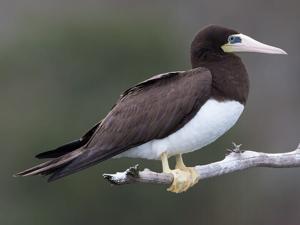
An example of this took place at Spring Mill State Park last month. Visitors were surprised to watch as a unique-looking tropical sea bird was spotted diving into the park’s lake to catch fish. Assistant state ornithologist Amy Kearns confirmed the bird as a juvenile sula leucogaster, a species more commonly known as a brown booby.
“This species is rarely seen in the United States let alone Indiana,” Kearns said, noting the bird had definitely wandered a good distance from its natural home range. This is the second time this species has been seen in the state. The first on record was on a private lake in Zionsville in May 2019. That bird only stayed for less than a day before it disappeared.
The bird seen recently stayed near the park’s Activity Center for several weeks fishing and resting on trees and a newly built floating dock. When word got out many took time to go see the rare bird. ”The last I heard there were over 5,000 people that traveled to the park to witness the unique bird,” said Whitney Yoerger, Outreach Director for the Indiana Audubon Society.
Brown boobies have a dagger-like bill and nest on cliffs in tropical climates. They survive by diving for fish, sometimes over 50 miles from land.
BIRD BANDING
July is dove banding season, when the DNR bands mourning doves across the state. This important research effort helps biologists estimate Indiana’s dove population. This helps determine harvest numbers for the upcoming season, which begins in September.
Banding migratory birds such as doves, ducks and geese help manage a complex and mobile resource helping gain important information on distribution, migratory routes, survival rates and reproduction. Biologists gather this information through bands placed on the bird’s legs.
This information is what was used to determine the national flyway system to manage migratory birds since 1950. It is still important today as annual information helps biologists determine our annual waterfowl hunting seasons.
The value of banding data is only fully realized when banded birds are recovered and band numbers reported to the Bird Banding Laboratory. Some recoveries are recaptures (including sighting of bands through spotting scopes) of live birds that are obtained from banders or other wildlife professionals. However, the predominant number of recoveries of dead birds come from the public, either by people who have found birds that have died, or by hunters who have harvested them.
For me personally, I am proud to be a member of a devout migratory waterfowl group appropriately named “Brothers of the Banded Bird.” We try to aid in research by taking every banded bird we can, within legal limits, during hunting season.
Harvesting a banded bird is a unique experience. Not only do you get some special “jewelry” for your lanyard but when you report the band you get a certificate where the bird was banded, its species, sex and age. Getting a band that offers a reward or “money band’ as we call them is extra special because they are rare. Plus you receive a cash reward which is nice.
Some people falsely believe reporting bands could lead to more restrictive hunting regulations. In fact, the more bands recorded the more confident biologists are in their data which allow more harvest opportunities while ensuring numbers are sustainable.
Reporting a band is simple. You can either call the number on the band or report it online at www.reportband.gov.
TOURNEY RESULTS
Members of the Kokomo Bass Anglers recently held a tournament on Morse Reservoir. First place went to Sam Taskey with three fish weighing five pounds, three ounces. Second place went to Dave Pross with two fish topping out at four pounds, 12 ounces. Jim Lorts rounded out third place with two fish dropping the scales at four pounds, 11 ounces.
• Ethan Miller came away the winner of the annual Dick Mugg Memorial tourney, held at the Kokomo Reservoir, with five fish totaling 9.48 pounds. Matt Cottrell and Matt Durben brought in second place and “big fish” honors with four largemouth bass weighing 8.33 pounds. Their largest tipped the scales at 3.08 pounds. Doug Pence reeled in third place with three fish weighing 7.38 pounds. Congratulations to Brad Parsons for receiving this Year’s Kokomo Reservoir Monday evening tournament series Angler of the Year.
• Paul Crow and Wayne Eades swept last Tuesday’s Delphi-Delco team bass tourney, held on Mississinewa Reservoir, with three fish weighing four pounds, nine ounces. A one-pound, 11-ounce fish was good enough to earn them “big fish” honors. Second place ended in a tie between the teams of Keith Milburn and Kyle Hobbs and the team consisting of Mike and Shane Harrison. Both brought in a fish tipping the scales at one pound, 11 ounces. Third place went to Jim Helvig with one fish weighing one pound, eight ounces.