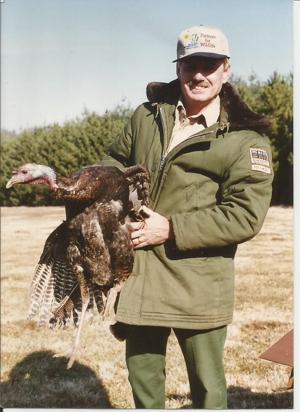
There is no doubt the American wild turkey sits on the throne as king of game birds. The large bird has created an entire specialized culture of hunters. They are also one of our country’s greatest conservation success stories. They hold a special place in my heart as well, which I’ll explain in a minute. Surprisingly it had nothing to do with a “click, bang!” or me standing over a beautiful long beard.
Technically, there are five subspecies of wild turkeys but by far the most popular is the Eastern subspecies. Maybe it’s because they inhabit the largest geographical area offering the most hunting opportunities.
In the early 1900s Eastern wild turkeys were pretty much wiped out of their range. Large-scale logging, land clearing and unregulated hunting lead to their demise. Then, in the 1950s conservation measures aimed at restoring wild turkeys began to take hold. Part of this was brought about by conservation programs funded by the Pittman Robertson Act, which places an excise tax on hunting equipment later returned to the states based on the number of hunting licenses sold. A few years later state conservation departments began receiving additional help from groups like the National Wild Turkey Federation.
There is no doubt habitat improvement and regulating wild turkey hunting played a major role in reestablishing flocks, but biologists agree the invention of the cannon net played a huge role as well. In the earlier years, some states tried releasing pen-raised birds with no success. It was simple. Birds raised in captivity could not survive in the wild. Biologists knew the only way to get turkeys into areas that had none was to release wild birds.
Trapping wild turkeys is almost impossible and when it did happen, it was only one bird at a time. The development of the cannon net allowed biologists to capture many birds at the same time. This system utilizes a serious of pipes loaded with lead weights attached to a large net. When fired simultaneously the net would be shot over an entire flock at once. Now biologists had the tools they needed. With this new trap and transplant measure along with habitat improvement and regulating hunting wild turkeys began to expand in states east of the Mississippi River.
It was sometime in the early 1980s when I began my own turkey hunting exploits. Back then that meant hunting in different states or in extreme southern Indiana. At that time only a handful of Indiana counties were open to turkey hunting.
It was late February 1996 when I received a call I will never forget. “Hey John, we are going to release wild turkeys in Western Howard County and want you to join us,” said now retired IDNR wildlife biologist Tom Hewitt.
The original reintroduction took place in the area which was then referred to as Stellite Park. “Most of our latest release sites have focused on areas in the northern part of the state,” Hewitt explained on that cool, drizzly morning. “Although Howard County is marginal in terms of habitat, we have been looking pretty hard at the western Wildcat Creek drainage for quite a while and we are going to give it a try,” he added. With that said, we began opening cardboard boxes containing the birds.
“Isn’t this something,” I said aloud as the first bird bolted from its enclosure. It was history in the making as we watched nine hens and three gobblers sprint on slender red legs before taking flight on raucous wings. They sailed over the tree-lined banks of the Wildcat. “Isn’t that beautiful,” said Hewitt, as we watched the birds soar across the gray, late winter sky. “Maybe in a few years you’ll be able to hunt close to home and won’t have to drive very far,” I’ll always remember him saying. “Yeah right,” I said in sarcasm. I could only hope. The thought of harvesting birds locally was a pipe dream, one I thought I’d never see in my lifetime.
Normally the DNR allows for the legal hunting of turkeys six years after they are reintroduced but in the case of Howard County, they opted to give it an additional year. In 2003 Howard County was added to the list of Indiana counties open to hunting. I couldn’t believe it. We went from no turkeys in this area to a population substantial enough to warrant a legal hunting season.
Wild turkeys are unusual birds. It’s hard to believe something with a brain the size of a peanut routinely outwits seasoned hunters every year. These elusive birds can be seen standing along roadways, gobbling at noises like someone slamming a car door or walking along urban neighborhoods with little regard. But when hunting season opens things change. They will spook and run at the slightest movement.
This spring’s wild turkey hunting season runs from April 24 to May 12. Youth season takes place April 20-21. A turkey hunting license and game bird habitat stamp are required.
If you have an opportunity to take part in the upcoming season, do not pass it up. Whether or not you succeed in taking a bird of your own, at least know you are enjoying one of our country’s greatest conservation success stories. In addition, by purchasing your license and hunting equipment you are helping continue the conservation efforts.