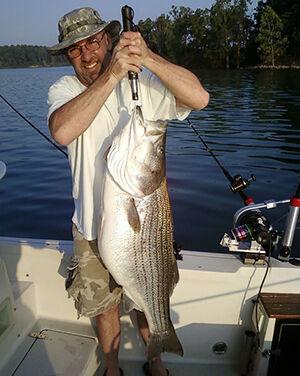
Anglers who have caught respectable size white bass (often called silvers) know the tenaciousness they possess. The same is said about their cousin, striped bass, which grow to larger proportions.
What some may not know is that Indiana offers some excellent opportunities for striped bass fishing as well as hybrid striped bass, sometimes referred to as “wipers.” These fish can provide an exciting experience for anglers who pursue these highly prized fish. Although full strain striped bass are not native to Indiana, they have been introduced into many Hoosier lakes and rivers.
Striped bass are an anadromous fish species, meaning they can inhabit both fresh and salt water. They are native to the Atlantic and Gulf Coast regions of the United States. Their ability to inhabit both fresh and salt water has allowed biologists to establish landlocked populations through specialized stocking programs.
Hybrid striped bass are a cross between our freshwater white bass and striped bass. These hybrids can tolerate warmer water temperatures, up to 90 degrees, making them more suitable for stocking into Indiana lakes and streams where habitat may be unsuitable for their full strain cousins.
The DNR stocks these fish to diversify fishing opportunities and increase predation in waters overrun with baitfish such as gizzard shad. Stripers and wipers are open-water predators and feed on schooling baitfish. These fish also grow much larger than our native white bass, allowing them to consume larger baitfish too big to be eaten by our native game fish. The current state record wiper rests at 22 pounds while the record striped bass is over 40.
Many times these fish can be spotted when they get baitfish schooled near the surface where they become easy prey. In some cases, anglers have caught them while “in the jumps,” or “firing on top.” It is common to see schools of these fish exploding on the surface as they feed on gizzard or threadfin shad. If you would happen to witness this, get as close as you can and begin casting. The fishing can be nothing short of phenomenal.
Striped bass require long stretches of free-flowing rivers with rocky and gravel bottoms to reproduce. This type of habitat is rare in Indiana. Because of this, hybrid and striped bass populations need to be maintained through stocking programs.
On a side note, wipers are a hybrid so their normal reproduction is minimal at best. While spawning is generally unsuccessful in Indiana, these species will still attempt to spawn by traveling into any inflowing stream systems connected to the lake as the water approaches 55 degrees Fahrenheit in the spring.
Striped and hybrid striped bass waters in Indiana include stocked lakes, reservoirs and rivers. Some of the best rivers include the Wabash, White and Tippecanoe. Popular tailwater fisheries exist below Oakdale and Norway dams, which hold back the waters of lakes Freeman and Shafer. The area below Lake Monroe is another popular spot. Several years back state-record wipers seem to come frequent at these locations.
To keep the momentum going, the DNR’s East Fork State Fish Hatchery recently completed their annual stocking. More than 78,000 striped bass fingerlings and 146,000 hybrid striped bass fingerlings were added to 12 Indiana lakes. The stocked fish averaged 2 inches in length. However, in a couple years will be providing anglers with additional opportunities.
The breakdown of stockings of striped and hybrid striped bass by lake, with the respective counties listed in parentheses, is as follows:
• Worster Lake (St. Joseph County): 3,270 hybrids
• Cedar Lake (Lake): 7,810 hybrid
• Lake Shafer (White): 12,910 hybrids
• Nyona Lake (Fulton): 1,040 hybrids
• Lake Freeman (Carroll and White): 15,470 hybrids
• Clare Lake (Huntington): 420 hybrids
• Shadyside Park Lake (Madison): 1,000 hybrids
• Cecil M. Harden Lake (Parke): 20,600 striped bass
• Brookville Lake (Union and Franklin): 46,667 striped bass
• Monroe Lake (Monroe and Brown): 53,750 hybrids
• Hardy Lake (Scott): 1,000 striped bass and 7,000 hybrids
• Patoka Lake (Dubois, Crawford and Orange): 10,000 striped bass and 44,000 hybrids
TOURNEY RESULTS
Bill and Jeremy Luster took first place and “big fish” honors at Tuesday’s Delphi-Delco bass tourney held on Mississinewa Reservoir. They won the event with five largemouth bass totaling 8 pounds with their largest tipping the scales at 1 pound, 14 ounces. Second place went to Kyle Hobbs and Keith Milburn with two fish weighing 3 pounds. Paul Crow and Wayne Eades rounded out third place with two fish totaling 2 pounds, 14 ounces.