The weather has definitely warmed up. Naturally, large numbers of people have gravitated to the water to enjoy swimming or myriad boating and paddling sports. Me included.
Several weeks back while enjoying a beautiful day fishing our Kokomo Reservoir I witnessed something that concerned me. While floating on the water’s flat surface, a smaller V-bottom boat passed by. It appeared to be piloted by a middle-aged guy. In the front seat were two children. Although everything appeared normal, I couldn’t help but notice neither the children or him were wearing life jackets.
Although the adult was old enough to make his own decisions, technically the children were not. In Indiana, anyone under the age of 13 must wear a life jacket when the vessel is underway. This includes gas and electric motors as well as paddling.
“Once they anchor, they do not have to wear one anymore,” said Tyler Blankenship, a park ranger at Monroe Lake in Bloomington, “although we advise the life jackets remain on. If the boat is underway, even by a trolling motor, the requirement is in effect. We are doing this to protect the children.”
Just taking a handful of seconds to strap on a life jacket seems simple enough, but a surprising number of boaters, many of whom are not proficiently able to swim, opt not to put on their life jacket, which can put them in a potentially dangerous position.
Water safety hits home for me personally. In 1999, I responded to the site of a drowning. It is a haunting memory I will never forget or ever hope to see again. Then there was another incident where a large group of family and friends had gathered for an Independence Day party. Many were taking advantage of the warm weather and the pond’s beautiful sandy beach area the owner had constructed.
While on shore, enjoying a plate of homemade food, I just happened to notice a young boy, eyes wide open and hands held up as he began to sink into the ponds deeper, olive colored water.
“Grab him! He’s drowning!” I yelled to one of my adult friends, who thankfully was in the water swimming and much closer to the boy than I was. The child was scared and the parents were thankful an accident was avoided. He never made a sound or thrashed his arms around like you would expect, until yelling for his mom after being pulled to the surface by my friend.
In reality, drowning is eerily silent. The Instinctive Drowning Response is the term used for what people do to avoid actual or perceived suffocation in the water. The dramatic waving, splashing and yelling is what TV portrays, but is rarely seen in real life. Except in rare circumstances, people that are actually drowning are unable to call out for help. Our respiratory is designed for breathing. Speech is a secondary function. Breathing must take place first before speech occurs.
People who are drowning usually cannot wave for help either. Nature instinctively forces us to extend our arms and press down on the water in an effort to keep us on the surface to breathe. According to the U.S. Coast Guard, people who are drowning can only struggle on the surface of the water from 20-60 seconds before submersion occurs.
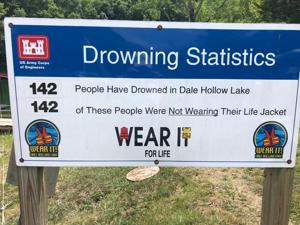
Each year when visiting Dale Hollow Lake I can’t help but notice signs posted at the many boat ramps. Unfortunately it has to be updated every year. Last year it read “142 people have drowned in Dale Hollow Lake. 142 of those people were not wearing life jackets.” Pretty sobering.
In Indiana there have been 216 drowning deaths from 2018 to 2021; 79% were males while 21% were females. The age group between 29-37 years of age represented the highest number of deaths. Although some, like fishermen and waterfowl hunters may be on the water year round, the majority of fatalities took place during the summer months.
There is no doubt almost every person involved the fatalities never thought it would happen to them.
It’s easy to become confused when considering the many models of life jackets, technically called personal floatation devices or PFDs. To keep it simple, there are five basic types. The first four types are wearable. They can be foam filled or inflatable. Type 5 is a throwable used to assist someone in distress.
Regardless of the type of PFD you use there are three things to consider. The first is to check the tag and make sure it is Coast Guard approved. The second is make sure the weight range is suitable for the person using it. Lastly, make sure it fits.
While typical life jackets don’t expire or have a shelf life, it is important people inspect them each year before use. Look for holes in the material, seam tears and threading that has become compromised or weak. Also, look at the floatation foam to see if it’s misshaped or if it has shrunk in size. Any of the above may compromise the flotation device, so it’s best to replace it.
Summers are made for us to enjoy the many water based fun activities. It’s even better when you enjoy them in safety, for us, as well as others. Just remember, life jackets float — we don’t!