DUBOIS COUNTY
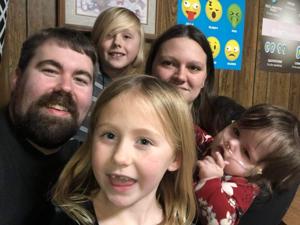
Two-year-old Izzy is one of countless Hoosier children who would suffer the negative impacts of proposed budget cuts by the Family and Social Services Administration (FSSA) for parents of medically complex children.
Severely disabled due to Dandy Walker Syndrome and Cerebral Palsy, Isabella eats from a feeding tube every three hours and relies on oxygen. She’s unable to move her legs much and cannot stand, nor walk. The soon-to-be adopted daughter of Josh and Kassie Elliott has been hospitalized repeatedly due to the severity of her conditions. Therapy is a routine; she attends speech, occupational and physical therapy five times per week, along with appointments with 12 different specialists.
Among those many trips is to visit Pediatric Therapy Specialities Physical Therapist Jayme Horton in Jasper. Horton said she is encouraging people to support and advocate for families and children who have special needs in the Dubois County community.
“When this came out a few weeks ago, we put together a group of parents who are in a similar situation so they could talk. It helped them unite and go to the legislators,” Horton said. “The state had this idea they aren’t taking the program away, they’re just taking away the ability for the parents to get paid. We’re still at a deficit of healthcare workers, so they’re going to take the program away, but there are no providers to fill that need.”
She explained during the COVID-19 pandemic, the State of Indiana opened the program’s capacity, allowing parents to stay home and care for medically fragile children and receive compensation through Medicaid.
“The need for people outside the home, like a nurse or someone is great, and the ability to find those people is very hard. Families have been able to provide a service to their child that was not being fulfilled,” Horton said. “Most families have both parents working and trying to provide care for their children. We see this in a lot of families, where they’re burning the candle at both ends. It enables one of the parents to stay home, which is huge.”
The Elliott family welcomed Izzy home in June 2022 at nearly five months old. Following a three-month stay in the NICU at Riley Children’s Hospital in Indianapolis, Izzy went home to her biological mother, where she suffered physical abuse and neglect, leading to starvation. She weighed just 9 lbs. at five months old, less than .1% for her age.
“My foster daughter is on a Medicaid waiver program (the Aged and Disabled Waiver). To qualify for this waiver, you have to have proof of severe, life-long disability that would typically require residential care. Only the most severely disabled children qualify for this program,” Kassie explained. “The purpose of this program is to assist people in remaining in their homes and communities.
“Part of this program is assisted caregiving. This is when an individual (typically a family member) is able to be employed through a home health company (at a low wage, typically $10 an hour) to provide care for the disabled individual because it is nearly impossible to keep a job when taking care of a kid that needs a specially trained caregiver 24/7 and the child needs to go to appointments and therapy daily. This program is common with elderly individuals as they near end of life as well.”
The family of five was faced with a difficult financial decision, allow their daughter to be cared for by a stranger or one parent leaves the workforce. As a registered nurse, Kassie’s income was higher, leading to Josh exiting his position as a corrections officer at Branchville Correctional Facility.
“My husband was able to start staying home with her and we were able to get some of the lost income back through this program and cutting our budget,” Kassie explained. “This ability to have a parent stay home to care for her is going to be especially important when our foster daughter starts school in one year and needs someone with her for those school hours plus therapy and appointments.”
At least three times each day, Izzy receives medications, along with rescue medications for her lungs and any seizures she may suffer.
“We have to get her in her standing wheelchair (stander) at least twice daily for two hours each session, as well as perform other stretches with her,” Kassie mentioned. “Josh currently manages all of her care by himself, while I am gone 14-plus hours per day, three to four days per week. Losing the attendant caregiver services would be absolutely devastating for our family. Izzy deserves to have care from her family and from someone who understands her needs.”
Last week, Indiana Lt. Gov. Suzanne Crouch convened a special meeting of the Indiana Intellectual and Developmental Disabilities Task Force regarding the proposed cuts to the Attendant Care program, part of an attempt to address a $1 billion shortfall in its Medicaid budget. The change is to be implemented July 1.
“We’re going to be judged by how we care about the most vulnerable among us. Let’s be judged in a positive way and a positive manner,” Crouch said Monday.
Last Friday, she urged Hoosiers to contact their local state legislators regarding the cuts.
“I’m deeply disappointed with FSSA, but it is hard to be angry when your heart aches for the families and caregivers of the precious children they are attending to. It truly is heartbreaking,” Crouch said in a statement Friday. “Since the meeting Monday, more and more families are contacting my office asking what can be done to reverse, or at least pause, these cuts. A group of families even came to the Statehouse Monday to meet with me and lobby their legislators. I tell all of them the same thing, ‘Contact your state legislators immediately!’ I am doing all I can to bring awareness to the severity and magnitude of the situation. So, I strongly encourage all Hoosiers to contact their legislators. Tell them these cuts need to be paused until we all get more answers, and we are confident these medically complex children continue getting the care they need.”
“I’m deeply disappointed with FSSA, but it is hard to be angry when your heart aches for the families and caregivers of the precious children they are attending to. It truly is heartbreaking,” Crouch said in a statement Friday. “Since the meeting Monday, more and more families are contacting my office asking what can be done to reverse, or at least pause, these cuts. A group of families even came to the Statehouse Monday to meet with me and lobby their legislators. I tell all of them the same thing, ‘Contact your state legislators immediately!’ I am doing all I can to bring awareness to the severity and magnitude of the situation. So, I strongly encourage all Hoosiers to contact their legislators. Tell them these cuts need to be paused until we all get more answers, and we are confident these medically complex children continue getting the care they need.”
House District 63 State Representative Shane Lindauer (R-Jasper) said he hopes the public outcry over the proposed cuts will stall waiver changes.
“I continue to hear from concerned and frustrated families and caretakers who will be negatively affected by FSSA’s proposed Medicaid waiver changes,” Lindauer said. “This has been a difficult issue for many families and discussions are ongoing at the state level. That’s why I encourage Hoosiers to share their stories during the agency’s public comment period. I’m dedicated to advocating for the affected families who rely on this waiver to take care of their vulnerable loved ones and I’ll continue to work toward finding solutions.”
While elderly individuals would still be able to receive care from paid family members, the proposed cuts would forbid the family of children to provide care and receive financial compensation.
“A hired unskilled caregiver cannot give her tube feedings, give her any medications, or perform several of her daily needs, because they are not considered to be within their scope of practice,” Kassie noted. “Parents are allowed to do this, because they are trained during doctor appointments with their child. So, a parent would still need to be with their disabled child at all times regardless of if we had a hired unrelated caregiver. If the parents affected by this policy change attempt to return to the work place, they will not have FMLA coverage for at least one year. This would be another factor making it very difficult to gain other employment while managing the care of a disabled child.”
Kassie said due to the low reimbursement rate from Medicaid, she has found nearly no non-relative caregivers employed through area home health companies.
“If this benefit is restricted to only non-family members, it would effectively become useless and force many families to put their disabled children in residential care to be able to return to normal jobs to support themselves and their other children,” Kassie added. “Also, kids like my foster daughter would have an even harder time getting adopted than they already do because the lost income costs of having to transition to having a stay at home parent would be too high for many individuals.
“Unfortunately, most people in our community are unaware of this issue. People don’t know about the services that are available to disabled children until they find themselves in the unfortunate situation of needing to use them. The services are already not enough. These children are difficult to care for. We are hoping to prevent cuts to funding for our state’s most vulnerable citizens.”